I love a fat post-game menu as much as the next sleep-deprived loot goblin, but some games need to learn the ancient lost art of stopping.
Not collapsing. Not getting abandoned. Stopping. Rolling credits, letting the music breathe, and trusting the player to walk away with a complete memory instead of a second job wearing legendary boots.
The modern endgame can be brilliant. It can also feel like a landlord found your hobby and started charging rent.
The clean ending is not a failure
Somewhere along the way, a finished game started to sound suspicious. If players beat it and leave happy, the spreadsheet asks a rude little question: but what if they stayed for another 400 hours?
That question has done damage. It has pushed perfectly good games toward daily objectives, repeatable currencies, prestige tracks, seasonal chores, and little notification bubbles that look innocent until you realize they have your evening in a headlock.
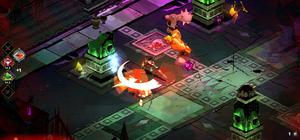
A clean ending is not a lack of ambition. It is confidence. Portal ends. Journey ends. Inside ends. Hi-Fi Rush ends. Hades technically keeps going, sure, but even there the loop works because the story, combat, and character writing all feed the same hungry machine. The extra runs are the game, not a desperate hallway bolted onto the back of it.
That difference matters. A good endgame grows out of the core fantasy. A bad one arrives after the credits wearing a fake mustache and asking if you would like to collect 30 wolf spleens for a cape shader.
The forever loop can flatten the magic
Games are already very good at making us chase numbers. Bigger damage. Shinier gear. A rank that moves up by one pixel after three matches and a minor emotional incident. I get it. Number go up, brain make tiny fireworks.
But when every game tries to become a forever game, the special stuff gets sanded down. The scary dungeon becomes a farm route. The beautiful world map becomes a checklist crime scene. The boss you survived by the skin of your teeth becomes Tuesday's efficient material source.
That is not always bad. Players love mastery. Communities form around mastery. Speedrunners, raiders, theorycrafters, build goblins, challenge runners: these people keep games alive in ways no marketing calendar can fake.
Still, there is a cost when the design assumes every player wants to live there. Some of us want to visit, get wrecked, learn the rhythm, win, and leave before the wallpaper starts asking for login streaks.
Retention is not the same thing as love
The ugly word behind a lot of this is retention. Not always, but often enough. Keep the player coming back. Keep the queue warm. Keep the store visible. Keep the battle pass close enough that missing a week feels like losing value, which is a very cursed way to describe leisure time.
That does not mean every long-running game is cynical. Destiny 2 has had raid moments that players will talk about for years. Diablo-style loot can turn repetition into comfort food when the combat, buildcraft, and reward pacing click. Monster Hunter understands that fighting the same creature again can feel fresh because the fight itself is the meal.
Long-tail progression works when the loop has teeth. It fails when the loop is just a padded room with XP dust sprinkled on the floor.
And yes, some players genuinely want one main game. They want a digital hometown. A clan. A ritual. A place where Tuesday night means raid night and everyone knows who forgot the mechanics again. That is real. That is valuable. I am not here to kick over anyone's loot altar.
I am asking for fewer games to pretend they are that kind of home when they are clearly a weekend rental with a reward track stapled to the fridge.
Shorter can hit harder
A game that ends can leave room in your head. That sounds almost quaint now, like saying a phone app should respect your battery, but it is true.
When a game ends cleanly, your strongest memory is not the last six hours of resource cleanup. It is the final boss, the last choice, the credits song, the line of dialogue that snuck up and punched you directly in the ribs. The shape of the whole thing stays intact.
Bloated endgames often replace that shape with sediment. Layers of currencies. Upgrade tiers. Vendors. Timers. Menus inside menus. Suddenly the thing you loved is still there, technically, but now it is under a pile of systems named after space minerals.
There is nothing wrong with a big game. There is nothing wrong with a repeatable game. The problem is the reflex. The assumption that every adventure needs an afterlife, and that the afterlife should have weekly objectives.
Let the credits mean something
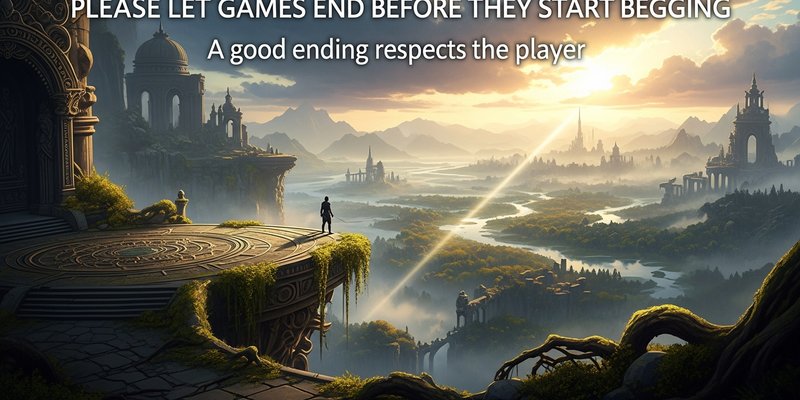
More games should be allowed to say: that is it. You had the meal. The plate is empty. Go tell someone whether it was good.
If the core systems can support another hundred hours, beautiful. Build the endgame. Feed the sickos. Let the buildcraft forum become a haunted library of spreadsheets. I will salute from a safe distance.
But if the best version of the game is a sharp 15-hour arc with a real ending, protect that. Do not stretch it into a lifestyle product because some dashboard got lonely.
Players do not need every game to move in. Sometimes the healthiest thing a game can do is finish, bow, and leave us wanting another one someday.