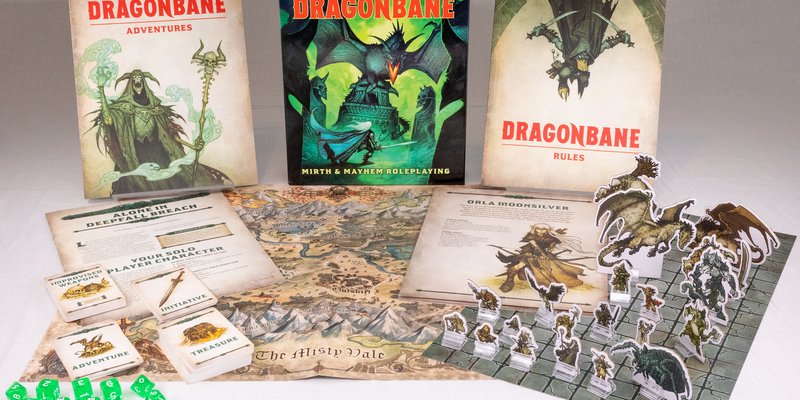
Your fantasy group does not always need a new campaign setting, a bigger monster book, or another character builder rabbit hole. Sometimes it needs a ruleset that gets people rolling dice before the snacks go cold. That is where Dragonbane makes a very clean pitch.
Free League calls it "mirth and mayhem roleplaying", which sounds like box-copy chaos until you look at what the game is actually doing. Dragonbane is the English-language revival of Drakar och Demoner, Scandinavia's old fantasy RPG line that dates back to 1982. This edition keeps the dangerous, slightly odd old-school flavor, then trims the table procedure into something a modern group can learn without assigning homework.
Why it works as a table reset
The big difference is pace. Dragonbane uses a skill-based D20 roll-under system: if your skill is 14, you want 14 or lower. A natural 1 is "rolling a dragon" and can trigger special effects. It is immediately understandable, and more importantly, it keeps the GM from explaining a stack of edge cases every time someone tries something risky.
Characters start with professions like fighter, mage, hunter, thief, artisan, merchant, mariner, and scholar, but those professions are not locked classes in the heavy buildcraft sense. They shape your opening skills and heroic ability. After that, characters can drift, grow, and become weirder through play. For a group coming from D&D, that can feel almost suspiciously light. Give it one session. The lack of build spreadsheets is part of the point.
It also has immediate table personality. Humans, dwarves, elves, halflings, wolfkin, and yes, mallards can go crawling through the Misty Vale looking for trouble. The duck adventurers are not a throwaway gag so much as a pressure valve. They tell the table, pretty loudly, that this fantasy world can be brutal without demanding grim seriousness every minute.
The GM gets to breathe a little
The best reason to look at Dragonbane might be prep fatigue. Free League presents the game as friendly to one-shots, longer campaigns, and easy-to-run adventures, and that matters if your regular GM is tired of building a small municipality every Thursday night. The core loop leans on exploration, hard choices, nasty fights, and compact rules rather than a mountain of encounter math.
That does not make it shallow. It means the friction moves to the table, where players are making decisions, instead of sitting in the GM's notes before anyone has arrived. If your group likes old ruins, bad plans, sudden violence, and laughing when the dice betray everyone, Dragonbane understands the assignment.
The line is growing, not sitting still
The core game already has a sensible entry path: Core Set, Rulebook, Quickstart Guide, Bestiary support, and campaign material such as Path of Glory. The more interesting signal is Dragonbane: Trudvang, Free League's 2026 Kickstarter that brings the Nordic-mythic Trudvang setting back as a standalone RPG based on the current Dragonbane rules. The campaign closed with more than SEK 10.7 million pledged and late pledges available, so this is not some lonely side experiment hiding in the corner of the hobby.
Trudvang is fully compatible with the base game and adds a bigger setting push: new kin, professions, heroic abilities, magic, a bestiary, a world book, and a revised four-part campaign. If you want Dragonbane as a lean fantasy engine first, the core set is enough. If your table wants a colder, stranger, more mythic campaign spine later, Trudvang looks like the obvious expansion path.
Who should skip it
If your group lives for deep character builds, crunchy tactical grids, or huge lore bibles, Dragonbane may feel too spare. It is not trying to out-D&D D&D. It is better treated as the game you pitch when everyone still wants fantasy adventure, but nobody wants to spend half the session negotiating rules density.
That is the useful lane: fast to teach, a little strange, dangerous enough to keep players honest, and light enough that a tired GM might actually want to run it. For some tables, that is not a compromise. That is the rescue plan.