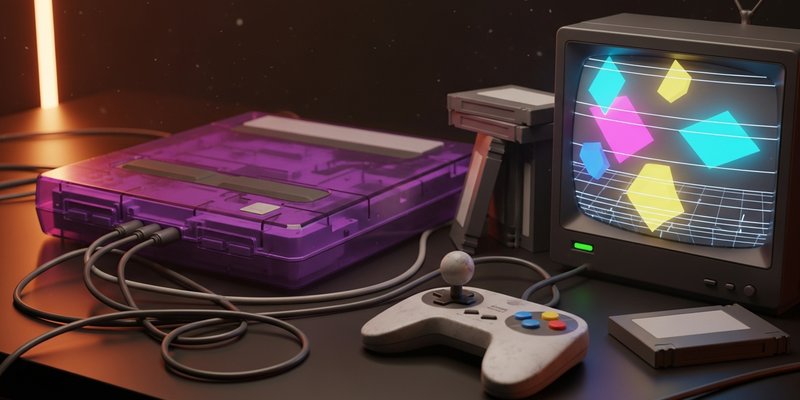
The Nintendo 64 is one of the funniest consoles to be nostalgic about, because on paper it sounds like a dare.
One analog stick. Three controller prongs. Cartridges in the age when everyone else was flirting with CDs. Textures that looked like someone smeared petroleum jelly over a dream. Draw distance? Bestie, the fog was the draw distance. And yet here we are, decades later, watching modern retro hardware like ModRetro’s M64 make the case that the N64 still has rent-free penthouse space in gaming’s collective brain.
That is not an accident. It is not just “remember when I was twelve” energy, although yes, that does help. The Nintendo 64 survives because its jank was attached to moments players actually lived in: four friends yelling at one television, impossible playground rumors, 3D worlds that felt enormous because nobody knew the edges yet, and a controller so strange it became part input device, part archaeological artifact.
The M64 Is Selling More Than A Box
ModRetro’s M64 pitch is extremely specific: an FPGA-based Nintendo 64-style console built around original cartridges, modern display output, a faithful physical design, and a controller that embraces the original trident silhouette instead of pretending it never happened. According to ModRetro’s own update, the company is targeting end-of-July shipping for the console, controller, and launch games, with features like a five-second boot-to-game flow, wireless OTA updates, a fanless design, an open-sourced FPGA core at launch, and support for original-style play.
Retro Handhelds has framed it as a lower-cost alternative to the Analogue 3D, citing a $199.99 price point and a design that leans harder into classic N64 identity: front controller ports, original-cartridge support, 4K output, and color options that know exactly which part of your childhood they are trying to mug in a parking lot.
But the interesting part is not merely that another company is making another nostalgia machine. The interesting part is that the N64, specifically, keeps inspiring this level of effort. If the retro market was only about clean design and technical elegance, the N64 would not be first in line. This was not a sleek console. It was a plastic spaceship with opinions.
Yes, The Controller Was Unhinged. No, We Are Not Over It.
Let us address the three-pronged goblin in the room.
The original Nintendo 64 controller looks like it was designed after a committee asked, “What if humans had one extra hand, but only sometimes?” It is iconic, yes. It is also ergonomically suspicious. The central analog-stick grip made sense for Super Mario 64. The left D-pad grip made sense for older-style games. The right-side C-button setup made sense until it didn’t. Then everyone just adapted, because children are resilient and gamers will normalize anything if GoldenEye 007 is involved.
That is why the M64 controller direction is so revealing. ModRetro is not simply replacing the shape with a generic modern pad and calling it a day. Its update describes a “best trident controller” approach with a TMR analog joystick, swappable stick, wired and wireless options, Bluetooth and USB compatibility for PC and Android, and compatibility with original Nintendo 64 hardware. Translation: the nostalgia is not just visual. It is muscle memory.
That matters. N64 games were designed around that weird little stick, those C-buttons, and that very particular feeling of fighting the hardware just enough to make victory feel personal. Clean it up too much and you risk sanding off the exact splinters people came back for. Nobody wants drift, obviously. But they do want the sensation of piloting Mario around Peach’s Castle like early 3D was being invented under their thumbs in real time.
The Ugly 3D Had Vibes, Unfortunately
Modern players are spoiled in the best way. We have crisp UI scaling, high refresh rates, ray tracing, HDR, ultrawide support, and enough texture detail to inspect a wall until it becomes a lifestyle. Going back to the N64 can feel like watching a YouTube video through soup.
And still, the vibes hold.
Super Mario 64 did not need pristine surfaces to make Peach’s Castle feel like a place. The Legend of Zelda: Ocarina of Time did not need modern facial animation to make Hyrule Field feel mythic. Majora’s Mask did not need photorealism to be deeply, wonderfully unsettling. Star Fox 64 did not need cinematic fidelity to make “Do a barrel roll” permanently lodge itself in the gamer bloodstream.
The N64’s look was often messy, but it was also readable in a dream-logic way. Big silhouettes. Strong musical identity. Strange skyboxes. Characters that felt like toys escaping the shelf. The technical limits became part of the emotional texture. Muddy? Absolutely. Memorable? Annoyingly, yes.
Couch Multiplayer Was The Secret Sauce
The N64’s real superpower was not polygon count. It was proximity.
Four controller ports on the front of the machine changed the social contract. No multitap. No accessory tax just to let the whole squad in. You brought controllers, snacks, and a willingness to accuse your friends of screen-looking with the fury of a courtroom prosecutor.
Mario Kart 64, GoldenEye 007, Perfect Dark, Mario Party, Super Smash Bros., F-Zero X — these were not just games. They were living-room incidents. Someone was mad. Someone was laughing too hard. Someone’s controller had the bad stick. Someone picked Oddjob and revealed their moral character. It was chaos with a cartridge slot.
This is the part that modern retro devices are trying to recapture, and it is not easy. Online play is convenient, but it rarely recreates the emotional violence of four people sharing the same tiny television while a parent tells everyone to keep it down. The N64 was built for that. Even its hardware layout screamed, “Invite people over and ruin a friendship responsibly.”
Preservation Is Not Just About Perfect Pixels
Nintendo already understands the appetite. Its Nintendo 64 Classics library through Switch Online + Expansion Pack includes heavy hitters like Super Mario 64, Mario Kart 64, Ocarina of Time, Majora’s Mask, GoldenEye 007, Banjo-Kazooie, Paper Mario, F-Zero X, and more. Nintendo also promotes original-style controller support, suspend points, online multiplayer, and even Switch 2 compatibility features like CRT filters and rewind.
That official route is valuable. It is convenient. It is legal. It is also curated, subscription-based, and inevitably limited by licensing, platform priorities, and whatever Nintendo decides belongs in the vault this year.
Hardware like the M64 exists because some players want a different kind of preservation: cartridges, original-feeling controls, low-latency play, modern displays, and a setup that treats the console as an object instead of a menu item inside a service. That is not automatically better for everyone. Subscriptions are easier. Original cartridges can be expensive. Retro collecting can develop rich-kid energy at terrifying speed. But the desire makes sense.
Preservation is not just “can this ROM boot?” It is also “does this game feel right when three friends are yelling next to me and the controller cable is somehow both too short and a trip hazard?” Academic? No. Accurate? Painfully.
So Why Does The N64 Still Hit?
Because it represents a rare moment when games were becoming 3D before the rules were settled.
Modern design is smoother, smarter, and usually less hostile to hands. But it is also standardized. The N64 era was full of experiments that had no template yet. Camera systems were weird. Movement was weird. Genres were mutating in public. Developers were solving problems players had never seen before, and sometimes the solutions were elegant. Sometimes they were crimes. Both became history.
The M64’s appeal is that it does not treat that history like a museum plaque. It treats it like something people still want to play. Not because it is flawless. Because it is specific. Because its imperfections have flavor. Because the moment you see a translucent purple shell, hear a familiar menu sound, or hold a controller shaped like a sci-fi boomerang, your brain goes, “Ah yes. The ancient nonsense. I missed this.”
That is the punchline and the thesis: Nintendo 64 nostalgia survives through the jank, not despite it.
The blur, the fog, the strange controller, the couch arguments, the cartridges, the impossible camera angles — all of it fused into a console identity that modern hardware makers are still chasing. The M64 might succeed or stumble on execution, price, availability, and whether its promises land cleanly. We will see. Retro hardware launches are not immune to their own little flop eras.
But the reason people are watching is already obvious.
The Nintendo 64 was awkward. It was bold. It was messy. It was magic.
And apparently, we are still not done holding the weird controller.