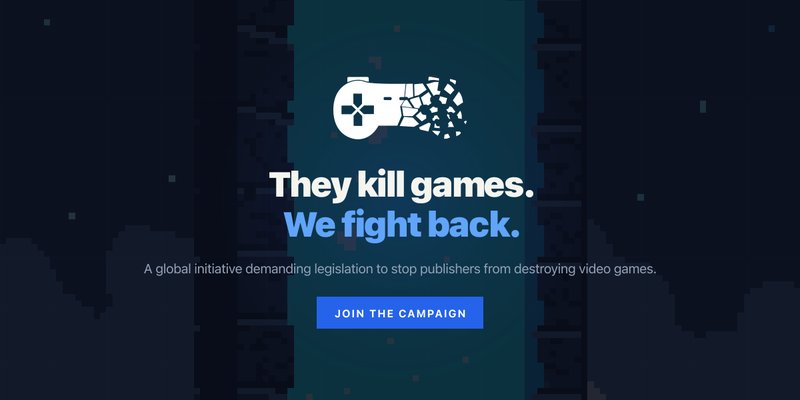
The European Commission has given Stop Killing Games the answer players did not want. No, Brussels is not proposing a new legal obligation that would force publishers to keep video games playable after commercial support ends.
That sounds like a hard defeat. It is not quite that simple.
In its formal response to the European Citizens' Initiative Stop Destroying Videogames, the Commission said it "cannot propose a legal obligation" at this stage. The reason it gives is intellectual property law: publishers and rights holders still have exclusive rights over their games, including the visual and technical parts that make a modern online game work.
But the Commission also said it will talk with the video game industry and consumer representatives before the end of 2026. The target is an industry code of conduct for how games are handled at the end of their life. Not a law. Not the big hammer campaigners wanted. Still, it puts server shutdowns, warning labels, refunds, and end-of-life plans on an official table instead of leaving them buried in angry forum threads.
What the EU is actually offering
The Commission's response has two main parts. First, it wants a dialogue with publishers and consumer groups about better standards for sunsetting games. Second, it says existing EU consumer law already gives players some protection when digital content fails to match the contract or what buyers could reasonably expect.
That second part matters because it shifts the argument away from "keep every game alive forever" and toward a more specific question: what did the player think they were buying, and what did the publisher clearly disclose before taking the money?
Commissioner Michael McGrath put it bluntly in the release: if a provider stops supplying a game earlier than the contract says, or earlier than consumers could reasonably expect, players should be appropriately reimbursed. That is not the same as preserving a game. It is closer to consumer redress after the damage is done.
For players, the practical takeaway is less romantic but more usable. Store pages, shutdown notices, offline modes, private server options, and refund language now matter even more. If publishers want to sell always-online games, the EU is telling them to be clearer about what disappears when the servers go dark.
Why players are angry
Stop Killing Games grew because players kept watching paid games become unusable after server shutdowns. Ubisoft's The Crew became the example everyone could point to: a game sold for years, then delisted, then shut down in a way that left owners with nothing playable.
The campaign's core demand is not that publishers run live-service support forever. It asks for games to be left in a reasonably playable state when support ends. That could mean offline functionality, private server tools, or another handoff that prevents a purchased game from becoming dead software.
The Commission did not accept that demand as a binding legal rule. For preservation advocates, that stings. An industry code of conduct can become polite wallpaper if publishers treat it as a public relations exercise. Players have seen enough sunset notices to be suspicious of promises about "dialogue." Fair.
Still, the response is not nothing. The Commission is acknowledging that game shutdowns are a consumer issue, not just a sad preservation footnote. It also says it will report on the application of EU digital content rules before the end of the year. That gives campaigners, consumer groups, and players something concrete to push against.
What happens next
The next fight is over the shape of that code of conduct. If it only asks publishers to write cleaner shutdown notices, players will have gained very little. If it pushes for plain storefront disclosures, realistic minimum support expectations, refund paths, and technical end-of-life plans, it could make future shutdowns harder to hand-wave away.
Players in the EU should keep an eye on consumer organisations and national authorities, because enforcement will likely happen through those channels rather than through one clean preservation law. Outside the EU, the response still matters as a signal. Platform holders and publishers do not enjoy writing one set of promises for Europe and a worse one everywhere else.
So no, Stop Killing Games did not get the headline victory. The Commission rejected the mandatory preservation law the campaign wanted. But the issue has moved from YouTube videos and petition pages into a formal policy process, and that is harder for publishers to ignore.
The boring version of the win is this: players now have a docket number, a deadline, and official language to quote the next time a publisher sells an always-online game with a sunset plan written in invisible ink.