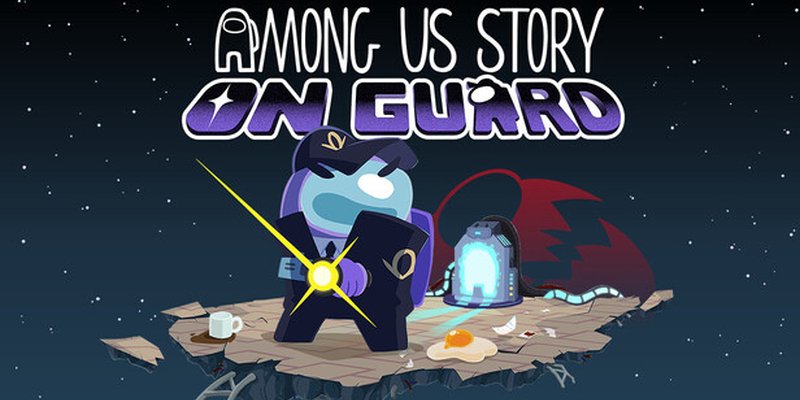
Among Us without the shouting lobby sounds wrong at first. That is the whole trick with Among Us Story: On Guard.
Innersloth has revealed a standalone single-player narrative adventure set in the Among Us universe, with a Steam page now live and a demo reportedly due on June 15. Instead of joining a group of friends and lying badly through emergency meetings, you play as Guard, a security role inside a MIRA crewmate training program where a murder turns the simulation into a proper whodunit.
The pitch is simple: prove you are innocent, identify the Impostor, keep the crew alive, and still do tasks because apparently even murder cannot stop workplace admin. Steam lists the release date as "To be announced", so this is not a launch-date story yet. It is a tone-and-format story, and that is more interesting anyway.
The weird part is also the point
The original Among Us works because people are messy. Someone panic-accuses the wrong player. Someone tells the truth so badly that it sounds like a lie. Someone says nothing for six minutes and somehow survives. Turning that into a single-player game strips out the live chaos that made the game explode during lockdown.
That could kill the magic. It could also give Innersloth room to do something the multiplayer game only suggests: make the player feel what it is like to be trapped inside one of those rounds after the jokes stop.
On Guard seems to understand that it cannot simply replay a normal match with bots. The Steam description points toward branching dialogue, investigation, tasks tied to clues, and three endings. Rock Paper Shotgun also notes a top-down presentation with a softer look, plus some first-person moments. That is enough to make it feel like a small detective adventure rather than a tutorial for the main game.
What players should watch in the demo
The demo will probably answer the important question quickly: are you actually investigating, or are you clicking through cute dialogue until the game tells you who did it?
For this spin-off to land, the deductions need some bite. Players should be able to notice contradictions, connect task evidence, read character behavior, and get punished for sloppy assumptions. The three endings matter only if they reflect decisions and missed clues, not just a final multiple-choice screen.
The tasks are another pressure point. In multiplayer, tasks give innocent players something to do while the Impostor hunts. In a solo detective story, they need a stronger job. They can pace the mystery, unlock locations, create alibis, or hide evidence in familiar little chores. If they are just nostalgia buttons, the joke wears thin fast.
Why this can work for Among Us
Among Us has always had more personality than plot. The beans are blank enough that players project everything onto them: betrayal, panic, fake innocence, petty grudges, terrible acting. A story spin-off gives Innersloth a chance to put names, voices, motives, and structure around that social energy without pretending this is suddenly a grim sci-fi crime epic.
The Steam page already leans into the right level of nonsense. There is a Cook, a Scientist, an Engineer, a Doctor who streams, a Captain, Management, and the Guard role you control inside the simulation. It sounds silly because it should. The danger is not that On Guard looks too goofy. The danger is that it might be too safe.
A good Among Us mystery should let the player be wrong. It should let the obvious suspect be a trap. It should make you second-guess a harmless crewmate because the original game trained everyone to distrust a bean standing near a vent.
The missing pieces
There are still practical gaps. Steam lists the game for single-player with full controller support and English plus eight more interface/subtitle languages, but the release date is not set. We also do not know how long it is, how much of the first-person material is playable, or whether the branching paths change more than the ending card.
That keeps expectations in check. This does not need to be huge. In fact, a tight two-or-three-hour mystery might fit Among Us better than a stretched campaign that explains every corner of the universe until the joke starts begging for air.
For now, Among Us Story: On Guard is worth a wishlist if you like detective games, visual-novel-adjacent mysteries, or just want to see whether Innersloth can make suspicion work when nobody else is in voice chat. The demo is the real test. If it lets us accuse a bean for the wrong reason and feel clever right up until the game proves us an idiot, we may have something.