Every now and then, a tiny circuit board wanders into gaming culture and refuses to leave. ESP32 is one of those boards. It is cheap, small, low power, and usually comes with Wi-Fi and Bluetooth baked in, which means hobbyists can turn it into a surprising amount of fun: pocket toys, desk controls, LED props, mini arcades, wireless scoreboards, and the kind of weird weekend gadget that makes a LAN table immediately more interesting.
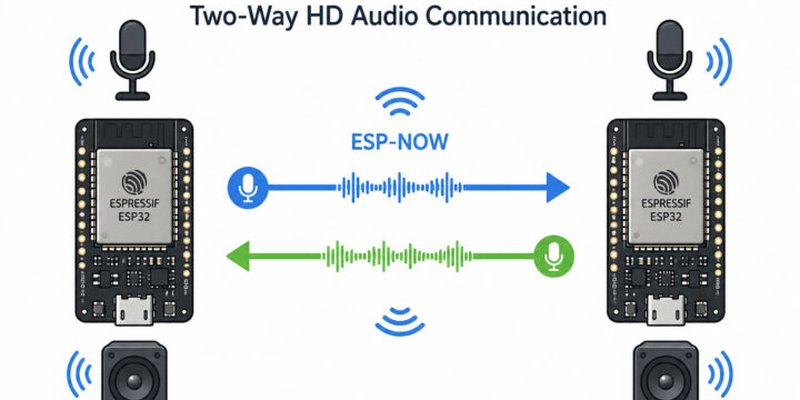
The latest excuse to talk about it is PCMFlow722, a library from Tanaka Masayuki covered by CNX Software. The short version: it lets ESP32 boards with a microphone and speaker send half-duplex HD voice over ESP-NOW using the G.722 audio codec. In normal human words, two little boards can act like simple push-to-talk walkie-talkies without needing a router in the middle.
That is not a game by itself, obviously. But it is exactly the sort of project that makes ESP32 fun for players. Think custom party-game props, tabletop RPG comms toys, couch co-op nonsense, escape-room puzzles, or a little "mission radio" for kids who have watched too much sci-fi and now need a foam blaster command network. I say that with respect. Half of good DIY is taking a serious chip and making it do something slightly ridiculous.

So what is ESP32, really?
ESP32 is a family of microcontrollers from Espressif. A microcontroller is not a tiny gaming PC. It is closer to the little brain inside a gadget: good at reading buttons, driving lights, talking to sensors, pushing pixels to small displays, and sending data over wireless links.
The reason makers love ESP32 is the value pile-up. Boards are inexpensive, examples are everywhere, Arduino and PlatformIO support are mature, and the built-in wireless saves a lot of hassle. If a project needs buttons, LEDs, a tiny screen, Bluetooth, Wi-Fi, or some dumb physical object to talk to another dumb physical object, ESP32 usually gets dragged into the conversation.
For gaming people, that opens a nice middle ground between buying an accessory and designing a full product from scratch. You can build a macro pad for MMO skills or OBS scenes. You can make a Bluetooth controller for a retro box. You can wire a status screen that shows Discord mute, stream state, raid timers, or a fake spaceship dashboard. You can also build a tiny handheld that runs simple games or emulators, depending on the board and the software stack.
The walkie-talkie bit is cooler than it sounds
PCMFlow722 matters because audio is usually where small projects stop being cute and start being annoying. CNX Software notes that G.722 gives 7 kHz audio at 16 kHz sampling while staying inside a 64 kbps budget. A 20 ms G.722 voice frame at 16 kHz is 160 bytes, which fits under ESP-NOW's 250-byte payload limit. Raw 16 kHz mono 16-bit PCM would be 640 bytes, so the codec is doing real work here.
The tested setup used M5Stack Core2 boards, which are friendly little ESP32 devices with a screen, speaker, microphone, flash, and PSRAM in a tidy case. That matters. A bare board on a breadboard is fine for experiments, but a project feels much more like a toy or prop when it already has a display and buttons instead of looking like it escaped from a drawer full of jumper wires.
The example sketch works like a push-to-talk radio. Hold button A and the device broadcasts audio over ESP-NOW. Otherwise, it listens. This is half-duplex, so it is not Discord in a match lobby. One side talks at a time. For a homemade prop or local play gadget, that limitation is part of the charm.
Project ideas that make sense for players
If you have never touched a soldering iron, start small. A game-room LED sign, a Stream Deck-style button box, or a tabletop initiative tracker will teach the basics without asking you to debug audio, battery charging, and wireless range all at once.
Once you are comfortable, ESP32 gets silly fast. A tiny retro handheld with a small screen and a few buttons can become a weekend project. A Bluetooth macro pad can sit next to a Steam Deck dock or PC keyboard. A wireless scoreboard can make fighting game nights or board-game sessions feel more official than they deserve. Add ESP-NOW voice and suddenly you are building short-range radio props for LAN parties, kids' games, or tabletop sessions where the GM wants one more toy behind the screen.
There are caveats. Cheap boards vary in quality. Audio projects need decent microphones and speakers. Battery builds need care, because lithium cells are not magic candy. Enclosures take longer than the code, somehow, every time. Range will depend on walls, antennas, interference, and how much you expect a tiny board to bully physics.
Who should try this?
If you like games and also like physical gadgets, ESP32 is a dangerous gateway drug. Not dangerous in the dramatic way. Dangerous in the "I was only going to make one macro pad and now I own a box labeled tiny screens" way.
Start with a board that has the parts you need already attached. M5Stack devices are easier for audio and display experiments because they package the messy bits neatly. For button boxes and LED props, cheaper ESP32 dev boards are fine, but expect wiring. If the project touches power, batteries, or anything worn on the body, slow down and read more than one guide before plugging things in.
PCMFlow722 is the fun headline because voice over ESP-NOW sounds like hacker camp nonsense in the best way. The larger point is simpler: ESP32 gives players a cheap path from "wouldn't it be funny if" to a real object on the desk. Sometimes that object is useful. Sometimes it is a glowing nonsense machine. Both count.
Sources: CNX Software's report on PCMFlow722 and Tanaka Masayuki's PCMFlowG722 project materials.