Valve has learned the oldest trick in platform warfare: you do not have to call something a console for everyone in the room to understand where it wants to sit.
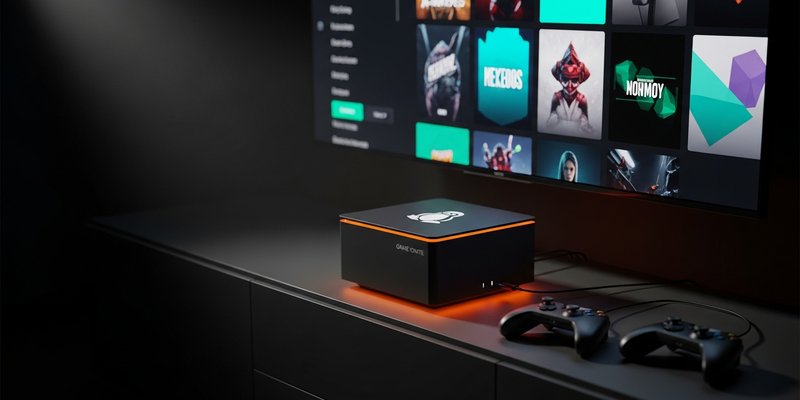
The new Steam Machine is officially a small-form-factor gaming PC. Valve’s own pitch is careful and very Valve-ish: your Steam library on the big screen, SteamOS under the hood, a roughly six-inch cube that can live under a television, on a desk, or — because someone at Valve still has a working sense of humor — hidden under a banana. It is a PC. It is open. You can install apps. You can even install another operating system if SteamOS is not your flavor of penguin.
But if we are being honest, this thing is absolutely picking a fight with the console-shaped part of the living room. Not necessarily a punch-the-PS5-in-the-mouth fight. More like Valve quietly walking into the lounge, plugging into the HDMI port, and saying, “What if your existing PC library was the console generation?”
The couch is the battlefield, not the spec sheet
The original Steam Machine era failed because it tried to sell an idea before the ecosystem was ready. The hardware was fragmented, Linux gaming was still wearing a lab coat, and the pitch often sounded like, “Here is a PC that behaves sort of like a console if you squint and ignore the weird compatibility gaps.” That was not a product category. That was a group project with too many captains.
This new attempt lands in a different world. Steam Deck happened. Proton matured from interesting compatibility layer into one of PC gaming’s most important bits of infrastructure. SteamOS now has a real consumer identity. Millions of players have already learned that a Linux-based device can boot straight into a game library, suspend cleanly, wake fast, handle cloud saves, and generally not require them to cosplay as a sysadmin before playing Elden Ring.
That matters more than a raw teraflop comparison. Consoles win because they make the living room frictionless. You press a button, sit down, and the box behaves. If Steam Machine can bring that same low-friction flow to the Steam library many players already own, Valve does not need to “beat” PlayStation or Xbox on paper. It needs to make the choice feel obvious on a Friday night.
Valve’s real weapon is your backlog
The strongest Steam Machine argument is brutally simple: you may already own its launch lineup.
Console launches traditionally sell you into a new ecosystem. A new box, a new store rhythm, a new set of subscription math, and usually a handful of cross-gen games wearing shinier shoes. Steam Machine flips that script. If it works as promised, you sign in and your Steam library is there. Indie games, AAA monsters, strategy games, weird experimental things you bought during a sale in 2018 and absolutely swear you will play someday — the whole digital attic comes with you.
That is not a small advantage. It changes the buying question from “Do I want another platform?” to “Do I want my PC games to become couch games?” For Steam Deck owners, the pitch becomes even cleaner: same account, same saves, same general interface language, but with more horsepower and a permanent place under the TV.
Valve says Steam Machine delivers more than six times the horsepower of Steam Deck and targets 4K gaming at 60 FPS with FSR. The FSR part is important. Upscaling is not a dirty word anymore; it is how modern boxes survive modern rendering budgets. Still, players should read that promise like adults. Native 4K at ultra settings is not the same thing as 4K output using reconstruction. The question is not whether FSR is “real” 4K. The useful question is whether games look good from the couch, respond well, and avoid fan noise that makes the living room sound like a tiny jet divorce.
SteamOS is the feature, not the footnote
SteamOS used to be the risky part. Now it is the product’s spine.
A living-room PC running Windows can be powerful, flexible, and deeply annoying. Anyone who has tried to manage updates, launcher pop-ups, Bluetooth weirdness, driver panels, and controller focus from ten feet away knows the pain. It is technically possible. So is eating soup with a screwdriver.
SteamOS gives Valve a way to hide the PC mess without deleting the PC freedom. That balance is the whole pitch. You get the console-like front end, gamepad-first navigation, quick access to Steam features, and a Verified-style compatibility signal expanding to Steam Machine. Underneath, it remains a PC. That means peripherals, mods, desktop mode, alternate apps, and the option to tinker if you want to. The trick is making sure players who do not want to tinker never feel punished for leaving the terminal alone.
This is where Valve has an unusually credible story. Steam Deck proved that the company can build a Linux gaming device that normal humans use daily. Not just hobbyists compiling kernels by moonlight. Normal humans. The little penguin that could has done more for Linux gaming than a decade of forum arguments ever managed.
The controller question is bigger than buttons
Valve is also pairing the Steam Machine with a new Steam Controller, and that is not a side quest. Input is one of the big reasons PC games can feel awkward on a television. Plenty of Steam games were built for mouse and keyboard first, and a basic console pad does not always solve that cleanly.
The controller’s trackpads, gyro support, back buttons, capacitive touches, and low-latency wireless integration are Valve trying to make the Steam library behave in places where traditional controllers struggle. Strategy games, management sims, older PC titles, launchers, menus, inventory-heavy RPGs — these are not edge cases on Steam. They are half the ecosystem.
If the new controller makes those games comfortable from the couch, Steam Machine becomes much more than a mini-PC. It becomes an interface translation layer between PC design and living-room habits. That is a wonderfully nerdy sentence, yes. It is also the difference between “cool hardware” and “thing people actually use.”
The caveats are real, and players should care
Now for the part where we keep our optimism patched and properly sandboxed.
- Price could make or break it. Valve has not given the final consumer price in the official material gathered here. If Steam Machine lands too close to enthusiast mini-PC territory, mainstream console buyers may shrug and stay with the cheaper box they understand.
- Anti-cheat remains the Linux boss fight. Proton compatibility is excellent for many games, but some major competitive titles still rely on anti-cheat systems that do not play nicely with Linux-based environments. If your entire gaming life is a specific multiplayer shooter with hostile anti-cheat support, check compatibility before falling in love.
- 4K/60 with FSR needs real-world proof. Valve’s target is exciting, but game-by-game performance will decide the narrative. Steam Machine Verified ratings will help only if they are clear, strict, and visible before players buy.
- Console convenience is a high bar. Sleep/wake, updates, controller pairing, HDR behavior, TV detection, audio routing, and family usability all need to feel boringly reliable. The living room is not forgiving. It has children, partners, guests, and exactly zero patience for “hold on, I just need to fix something.”
That last point is especially important. PC gamers tolerate friction because flexibility is part of the deal. Console players are buying their way out of that friction. Steam Machine has to satisfy both tribes without making either feel like they received a compromised toaster.
Where this pressures PlayStation, Xbox, and Switch 2
Steam Machine is unlikely to replace the cultural gravity of PlayStation exclusives, Nintendo’s first-party magic, or Xbox’s subscription strategy overnight. It does not need to. Its pressure comes from a different angle.
For PlayStation and Xbox, Valve is attacking the assumption that the living room requires a closed ecosystem. If a player can get a console-style interface, an enormous existing library, strong indie support, modding potential, cloud saves, and PC flexibility in one box, the old trade-off starts looking less absolute.
For Switch 2, the fight is stranger. Nintendo owns portable-first family-friendly design in a way Valve cannot simply brute force. But Steam Deck already proved that many players want handheld PC access. Steam Machine could become the home anchor for that same audience: Deck on the go, Steam Machine on the TV, one library connecting both. That is not Nintendo’s model, but it is a compelling parallel universe.
And for Xbox specifically, there is a spicy little strategic wrinkle: Microsoft has spent years blurring the line between console and PC through Game Pass, Windows, and cloud services. Valve is blurring it from the other direction, starting with PC ownership and pushing toward console convenience. Same bridge, opposite lane.
The quiet console fight
The most interesting thing about Steam Machine is that it does not need to declare a console war to become part of one. It simply has to normalize the idea that the best living-room gaming box might be an open SteamOS PC with a controller-first interface.
That is a very Valve kind of disruption: less marching band, more infrastructure. Give players access to what they already own. Make the box quiet. Make the interface sane. Make performance legible. Let tinkerers tinker, but do not make everyone else read a wiki before launching a game.
If Valve nails those basics, Steam Machine could become the most credible living-room PC yet. Not because it is the most powerful machine in the house, and not because it magically erases consoles. Because it understands the part of console gaming players actually love: convenience.
And if that convenience arrives with Steam’s library, SteamOS openness, and the option to install whatever you want underneath? Well. That is not a console by name.
It is just standing under the TV, wearing console-shaped boots, asking your backlog if it wants to come out and play.