I do not want my game launcher to have a personality. I want it to remember my library, keep cloud saves from turning into confetti, patch games without drama, and then politely vanish. That sounds boring, which is exactly the point. The best platform feature in PC gaming is restraint.
Steam did not win player trust because every corner of it is beautiful. Some corners still look like they were assembled in a back room full of beige keyboards and strong opinions about window borders. It won trust because, most of the time, it behaves like infrastructure. You open it, find the game, hit play, and the platform fades into the wall. When PC gaming is already a circus of drivers, overlays, storefront accounts, controller quirks, shader compilation, and mystery update notes, fading into the wall is not a small gift. It is the whole bargain.
Friction is the tax players remember
Players forgive a lot when the game is good. We will tweak settings for an hour. We will install a 90 GB update because a friend swears the new season is better. We will even tolerate launch day queues, because apparently suffering together counts as community now. What we remember, though, is friction that has nothing to do with the game.
A second launcher opening after the first launcher is one of PC gaming's most cursed rituals. You buy a game in one place, press play, then another window wakes up like a vampire in a branded hoodie. It wants a login. It wants an update. It wants to show you a sale for a different game while the one you paid for waits in the corner. None of that makes the game better. It just reminds the player that every company wants to own the doorway.
That is where Steam's boring competence matters. Library management, patching, refunds, cloud saves, controller support, wishlists, reviews, Workshop, family sharing, the Steam Deck compatibility layer: the list is messy, but the center holds. Most of these tools sit there until the player asks for them. They are not perfect, and Steam absolutely has its own clutter. Still, its best trick is that it usually treats the act of playing as the main event.
Competition is good. Interruptions are not.
The fair counterpoint is obvious: Steam should not be the only serious PC storefront. Competition matters. It can pressure fees, fund exclusives, improve refunds, and give developers more ways to reach players. GOG has a clear pitch with DRM-free games. Epic has spent real money getting games in front of people who might not have tried them otherwise. Even publisher launchers can make sense when they support account features, cross-progression, or online services the game genuinely needs.
But competition does not become player-friendly just because a different icon appears on the taskbar. If a storefront competes by adding steps, hiding settings, pushing pop-ups, or treating the library as a billboard with a play button attached, players notice. They may still use it. Free games are free games, and exclusives work because people want the games. That is not the same thing as trust.
Trust is quieter. Trust is when a platform handles the boring parts often enough that you stop thinking about it. Trust is when the refund button is not a treasure hunt. Trust is when a cloud save follows you to a handheld without a tiny prayer to the sync gods. Trust is when controller support does not require a forum thread from 2018 and three comments saying "worked for me."
The Steam Deck made the lesson harder to ignore
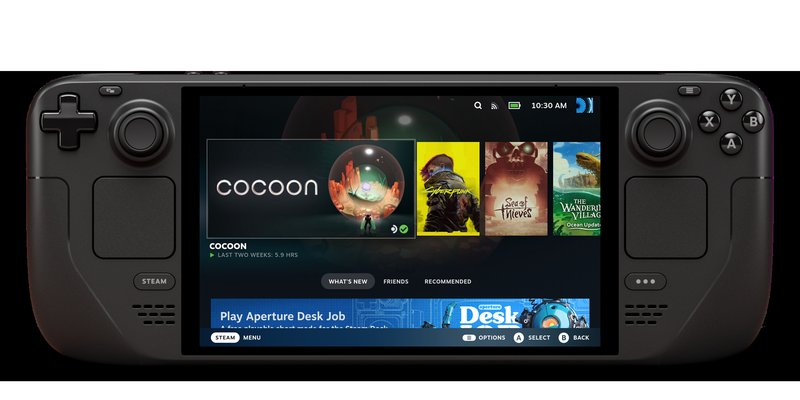
The Steam Deck is a useful example because it turns platform friction into something physical. On a desktop, you can brute-force your way around annoyance with a keyboard, a browser tab, and grim determination. On a handheld, every extra login box feels larger. Every launcher that expects a mouse cursor feels sillier. Every pop-up that was merely annoying on a monitor becomes a tiny obstacle course on a seven-inch screen.
That is why the Deck's strongest feature is not raw power. It is the illusion that PC gaming can be console-simple without giving up the weirdness that makes PC gaming fun. The illusion breaks sometimes. Anyone who has wrestled with anti-cheat support, non-Steam games, or a launcher that refuses to behave in Game Mode knows the edges are still sharp. But the target is right: make the platform serve the game, not the other way around.
That should be the standard everywhere. A launcher should earn its place by making play easier. Better patch control? Great. Cleaner mod support? Lovely. Honest compatibility notes? Keep going. A storefront that remembers what I own, respects my time, and helps me get back into a game after three months away? That is useful. A storefront that mainly exists to capture attention between me and the thing I launched? Into the bin with the other cursed utilities.
Getting out of the way is a design choice
There is a temptation in platform design to confuse visibility with value. If the service is important, surely the player should see it. Give it a home page. Add a feed. Add a rewards badge. Add a seasonal takeover. Add one more notification, because the growth chart needs a little snack.
Players do not experience that as value. They experience it as noise. The more a launcher insists on being noticed, the more it feels like something to survive before the game starts. PC gaming already asks players to tolerate enough weirdness. The platform that wins long-term affection is not the loudest one. It is the one that quietly keeps the pipes from leaking.
So yes, give me competition. Give me better storefronts, fairer terms, smarter libraries, and launchers with actual reasons to exist. Just do not confuse the door with the destination. If I remember your launcher more vividly than the game I opened through it, something has gone wrong.